
How did the Chief expect a student to spend their Tuesday morning?
One of Dr Felkin’s quiet contributions to the Order was to develop something that had remained largely unrealised within the curriculum inherited from the Isis-Urania Temple: how the Candidate was to continue the Work after the Ceremony had ended.
While Initiation could impress the current of the Grade upon the Candidate, the Ceremony alone could not sustain that current.
To this end, Dr Felkin and the Stella Matutina developed a coherent regime of discipline.
Each Grade was accompanied by a Daily Rhythm: a sequence of recitations arranged throughout the day, almost entirely drawn from the texts of the Ceremony itself. Morning, noon, evening, and night, the Candidate repeatedly returned to the central current of the Grade. The Ceremony ceased to be a single event and became part of daily life.
The Daily Rhythm for the Neophyte illustrates this method:
On Rising: Neophyte Sign.
“Out of the Darkness let the Light Arise.”
Noon:
“Lord of the Universe the Vast and the Mighty One, Ruler of the Light and of the Darkness, we adore Thee and we invoke Thee.”
Evening:
“Fear is failure: be thou without fear for he who trembles at the flame and at the flood hath no part in God.”
Night:
“Glory be to the Father of the Undying, for Thy Glory flows out rejoicing to the ends of the earth.”
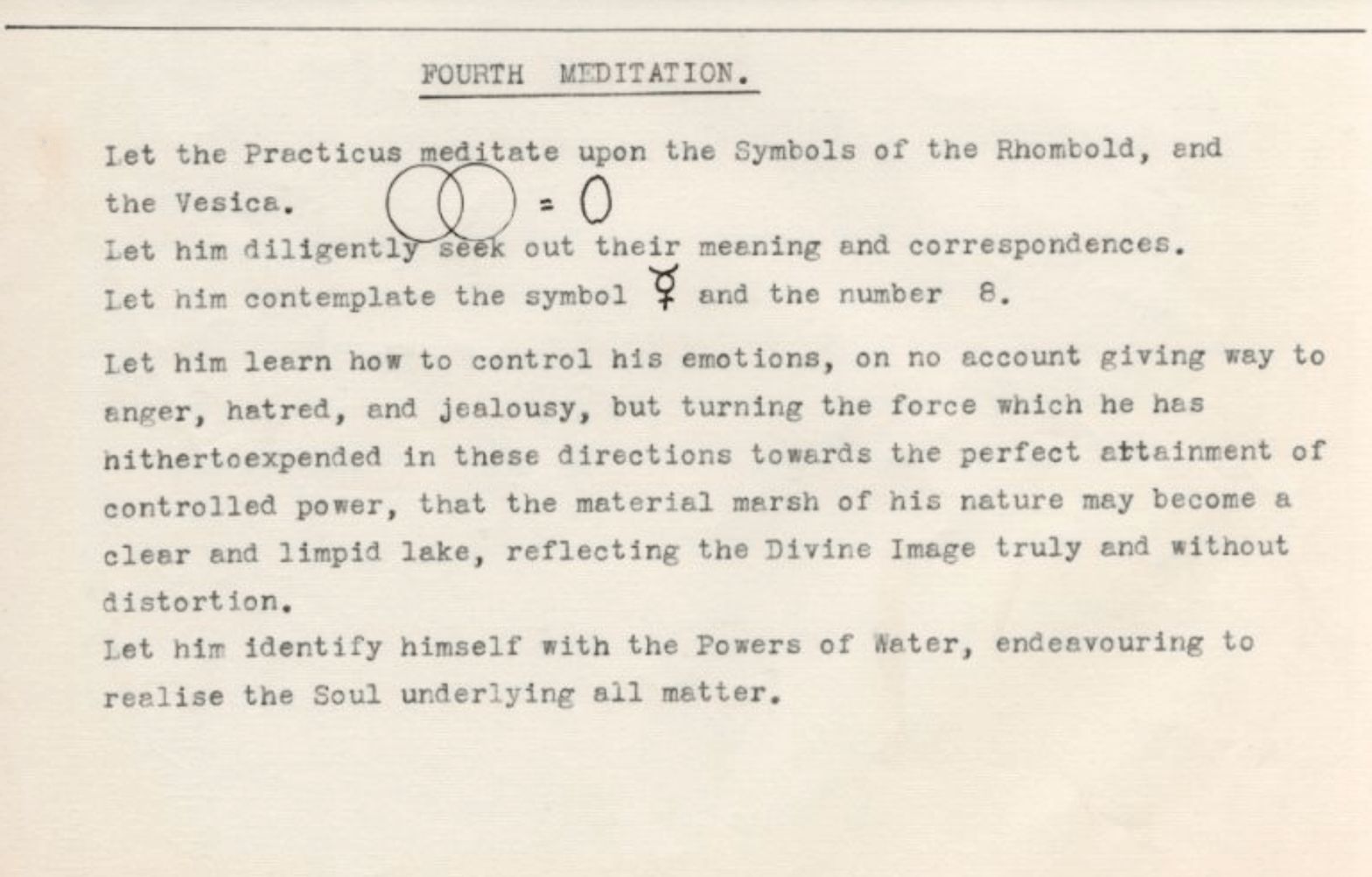
Alongside this stood the Grade Meditations. Their purpose was to actively engage with the Work and awaken intuition by requiring the Candidate to seek fresh insight into the symbols of the Grade. The Demonstrator reviewed each student’s meditation notes, not to provide answers, but to encourage the gradual emergence of inner tuition.
This method did not cease with the Outer Order. Daily Rhythms and Grade Meditations continued throughout the Adept’s progression, even to the highest grades of the Order. They accompanied the Adept through decades of ceremonial practice, demonstrating that the Work was understood as a lifelong discipline rather than a succession of isolated initiations.
Together, Ceremony, Daily Rhythm, Meditation, and the guidance of the Demonstrator formed a single, integrated praxis.
The Ceremony implanted.
The Daily Rhythm sustained.
The Meditation unfolded.
The Demonstrator guided.
The object was not to remember the Ceremony, but to continue it.
Perhaps it is here that Dr Felkin’s contribution is most clearly seen. He did not merely preserve the ceremonial inheritance of the Golden Dawn. He quietly shaped a disciplined way of living the Work for decades.
Kasmillos
Note: The accompanying image is taken from a Whare Ra document entitled Syllabus and Meditation 3=8 to 4=7, issued to newly Advanced Practici. An almost identical instruction appears in the early Stella Matutina Meditations for the Grades, prepared by V.H. Soror Quaero Lucem, a copy of which is held in the collections of the Museum and Library of Freemasonry, London.
