Renaissance Hermeticism (more precisely Hermetic Platonism) as advanced by Marsilio Ficino (1433–1499), provides an interpretive key through which the Order’s methods of Initiation, practice of meditation, and discipline of silence can be understood.
This framework is not an adjunct to our practice; it is one of the fundamental philosophical and ethical keys through which the Order’s purpose becomes intelligible and operative.
When the Work is approached in this manner, one begins to glimpse something of the contemplative culture within which the Whare Ra Adepti pursued the Great Work.
Kasmillos
“May what we have partaken of sustain us in our search for the Quintessence, the Stone of the Philosophers, True Wisdom, and Perfect Happiness – the Summum Bonum.”
1. The One God — The Summum Bonum
At the summit of reality stands the One God, identified with the Good. This principle is absolute unity: transcendent, ineffable, and beyond all form, name, or qualification. It is not a being among beings but the source of all being itself.
2. Nous — Divine Intellect
From the One proceeds Nous, the Divine Intellect. Nous is the first intelligible manifestation of God and the true light by which God is known. It is both divine consciousness and the pattern of intelligibility itself. Humanity participates in Nous through purification, awakening, and direct knowledge.
3. Logos — Divine Reason and Ordering Principle
From Nous proceeds Logos, the active rational principle that orders and structures the cosmos. Logos is the mediating power through which divine intelligence shapes nature, establishes law, and gives form to being.
4. The Cosmos as a Living and Intelligent Whole
The universe (kosmos) is a living, ensouled, and intelligible organism governed by divine reason. Nature is sacred, ordered, and purposeful. There is no inherent opposition between spirit and nature; the material world is the visible manifestation of God, not a prison.
5. Humanity as a Liminal Being
Humans occupy a unique intermediary position. They possess an immortal intellect (nous) capable of divine knowledge, and a mortal body subject to generation and decay. This dual nature situates humanity between the intelligible and the animal realms.
6. Fate (Heimarmene) and the Planetary Powers
The material cosmos is governed by fate, administered through planetary and cosmic forces. Ordinary human life is bound by these influences insofar as consciousness remains identified with the lower psychic and bodily levels. Fate governs the unawakened, not the enlightened.
7. Gnosis as Liberation
Restoration is achieved through gnosis: direct, experiential knowledge of God and of the self as rooted in the divine. Gnosis is not belief, dogma, or sentiment, but an awakening of consciousness to its true source.
8. Ethical and Ascetic Purification
Moral discipline, self-mastery, and reverence for the divine are indispensable conditions. Ethics serve an initiatory function: they purify perception and loosen the soul’s attachment to passion.
9. The Ascent of the Soul
The tradition teaches the ascent of the soul through the planetary spheres, whether post-mortem or symbolically enacted during life. At each stage, the soul relinquishes material qualities and passions, progressively restoring its primordial spiritual simplicity.
10. Piety, Reverence, and Silence
Authentic knowledge culminates in humility, piety, and silence. God ultimately exceeds language; discursive speech yields to contemplative knowing. Silence is not absence of knowledge, but the natural terminus of true understanding once knowledge has been exhausted.
“For strength is in Silence, and the seed of Wisdom is sown in Silence and grown in darkness and mystery.”
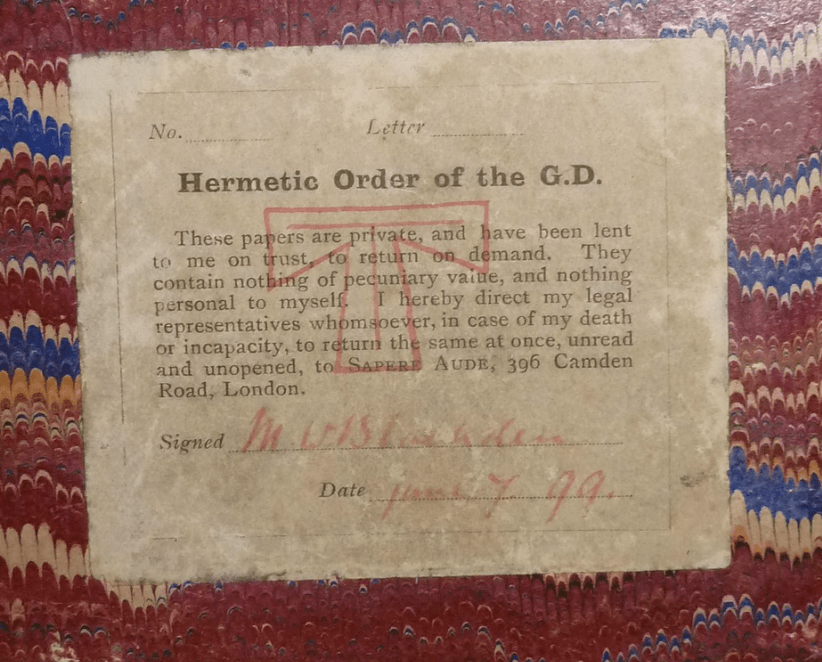
Note: Accompanying image is of a G.D. Label from 1899 on the cover of a copy of Book T – transcribed by V.H. Fra. Ma Wahanu Thesi (M. W. Blackden). Original held in the collections of the Museum and Library of Freemasonry in London.
