I am conscious of the privilege of having worked with Frater Fiat Lux, 7=4, a member of Whare Ra since the 1930s. With the passing of that generation, very few remain who were formed within the old Temple culture. Most who now approach the Order do so through its published corpus.
Fiat Lux trained me as he had trained others since his appointment to the Office of Demonstrator in 1959. The word is chosen deliberately. He did not teach in the academic sense. He did not lecture to inform. He did not provide commentary to be admired or debated. He trained.
Training implies formation over time. It implies repetition, correction and accountability. It implies that something is being shaped. Information accumulates; training forms.
The modern student of the Golden Dawn has access to an abundance of material. Rituals are published. Papers circulate freely. Lectures are recorded. Commentary is bountiful. This accessibility has preserved much that would otherwise have been lost, and for that we may be grateful. But access to information, however extensive, is not the same thing as formation within a current.
The difference is in method; it is neither romanticism nor obsolete in application today.
What then was I trained to do by Whare Ra’s Demonstrator?
I was trained to take the long view. Initiation was understood not as a conferral but as a current set in motion. Advancement did not signal accomplishment; it intensified responsibility. Years mattered. Rhythm mattered. Momentum mattered. The work was cumulative and compounding.
I was trained to value discipline. Without discipline, meditation becomes occasional, study becomes selective, and ceremony becomes rehearsal. With discipline, even the simplest prescribed exercise acquires weight. Discipline (and activity generally) was regarded as the first evidence of alignment with the Higher Principle toward which the work appeals. It was not a personality trait but evidence that orientation was occurring.
I was trained in the utilisation of Silence in my work. Not secrecy for its own sake, nor concealment for the sake of exclusivity, but Silence as method. Insight was to be tested inwardly before it was spoken outwardly. Premature discussion was considered a dissipation of force—the alchemical vessel must remain sealed if the operation is to proceed. Practically, silence curbs inflation. It prevents the ego from feeding on disclosure.
“So help me my mighty and secret soul, and the Father of my Soul, Who works in Silence and Whom nought but Silence can express.”
I was trained to think independently within the framework of the Order’s system. Questioning was not discouraged, but neither was it indulged prematurely. One was expected to stand before a diagram, a ritual, a meditation topic, and work with it until something living emerged. Intuition was cultivated deliberately.
Above all, I was trained to rely upon the Ceremonial as the core corpus of the Order. The Rituals were not dramatic appendices to theory. They were the engine and cipher of the method. They were approached as sacred rites, for the Great Work was understood to require sanctity.
The lectures elucidated; the Ceremonial Initiated.
The papers supported the ceremonial; they did not replace it.
Commentary was secondary; experience was primary.
Those who have only encountered the Golden Dawn through its printed material may understandably reverse this order. The structure can appear to be primarily doctrinal, supported by theatrical rites. Within the temple culture in which I was formed, the reverse was true. The rites carried the current. The documents served them.
The themes that have characterised my work over the past four decades are, therefore, not personal preferences. They are the direct continuation of the method in which I was trained—discipline, silence, sanctity, self-reliance in symbolic interpretation, and the centrality of ceremonial.
None of this denies the value of study. Study is indispensable. Nor does it imply that serious work is not being undertaken in contemporary temples, or by solo practitioners. It is simply to state that without time, discipline, sanctity, regular ceremonial, and silence, the Order’s system becomes descriptive rather than operative.
Information rather than formation.
Whare Ra did not seek to produce commentators. It sought to form workers.
That distinction is decisive.
Kasmillos
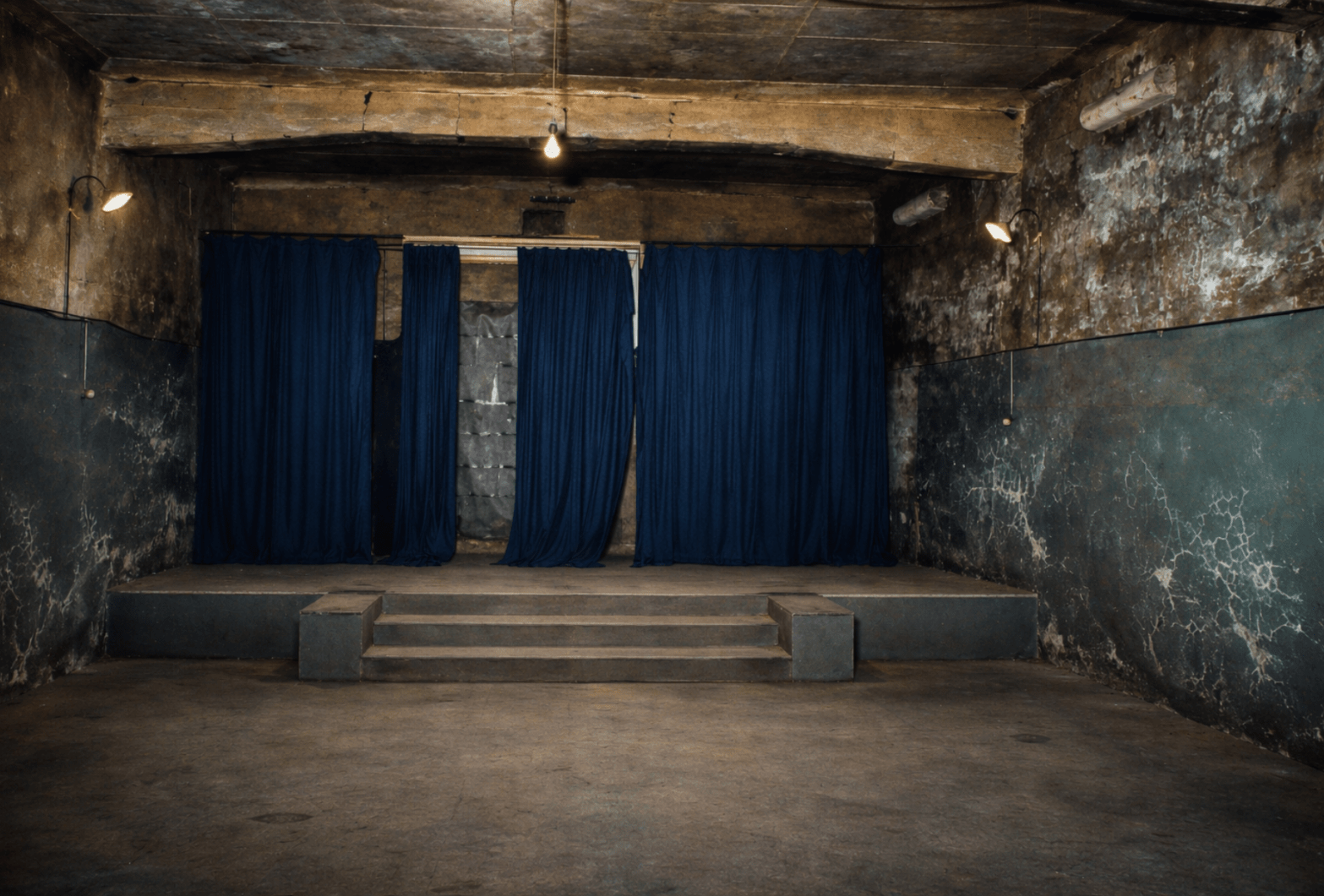
Note: The image above is based on an archival photograph from the Hastings District Council collection (c.1983) showing the interior of the Smaragdum Thalasses Temple after the Order had closed, when the room was being used for storage. Various later items visible in that photograph have been digitally removed here in order to show more clearly the architectural structure of the temple space itself.
