From the series “On the Work of the Grades” – reflections on the path of the Candidate through the Grades
The work of the Theoricus is to awaken the inner sense — to perceive not only through the eyes or the intellect, but through the awareness of the intelligence that lies beneath and binds all of life.
At this stage of the Path, the student should begin to see instinct not just as an animalistic impulse, but as a common intelligence.
It is the subtle directive force that draws the acorn toward its oak, the bird along its migration, the newborn toward its first breath.
It is the first stirring of motion within Nature: the bridge between life and matter.
The Theoricus should endeavour to observe this intelligence at work in all kingdoms — in the rhythms of their own being; in the actions and reactions of others; in the enduring patience of plant and animal life; and, in time, even within the stillness of the mineral kingdom as a kind of latent potency.
This shared intelligence is present as a current flowing through the pulse of existence. A pulse which oscillates between two poles: attraction and repulsion, motion and rest, action and reaction.
“Those Eternal Forces, betwixt which in equilibrium the Universe dependeth.”
Within the Temple, this principle is expressed most clearly in the Offices of the Stolistes and the Dadouchos, who move in synchrony where possible — one bearing the water that purifies, the other the fire that consecrates. Together they sustain the rhythm of equilibrium, symbolising that all growth arises through this interplay of opposing forces.
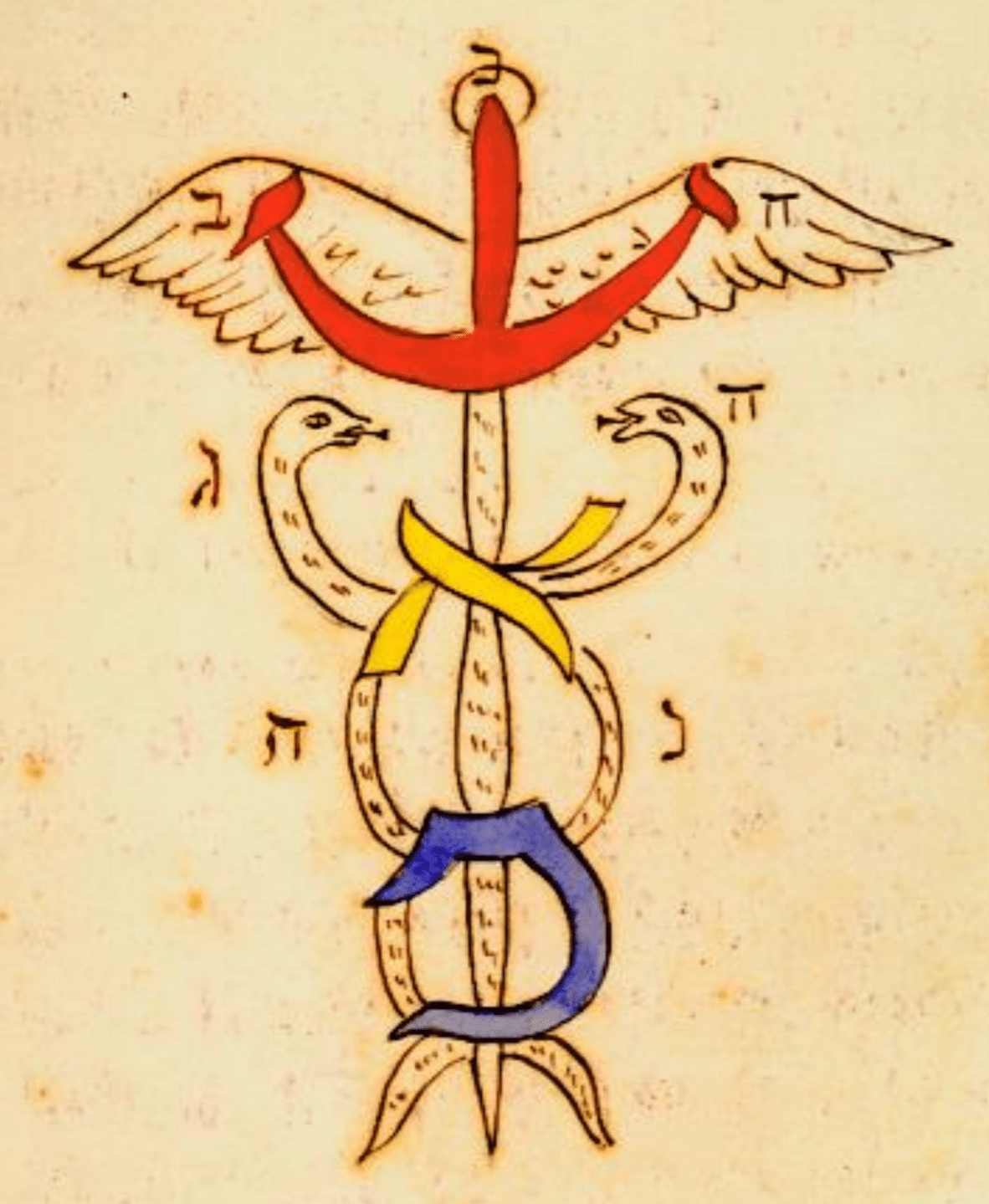
This pulse is also shown, in a more esoteric sense, in the imagery of the Caduceus and the Lamen of the Kerux.
So to perceive this dance of opposites is the first step toward mastery of Nature. The Theoricus is not yet required to command these forces, but simply to perceive them — to sense when one dominates, when the other withdraws, and when balance is restored.
For this reason the Theoricus stands symbolically between the Two Pillars of the Temple in Yesod — that foundation from which the Soul’s earliest emergence into consciousness occurs.
Note that the Pillars are not conflicting symbols as such, but represent dynamic balance: the eternal tension, the interaction between them by which creation endures.
So the task of the Theoricus is to perceive instinct in this deeper sense — as an intelligence common to all — and to hear, however faintly, that oscillating rhythm that motivates life itself.
Kasmillos
