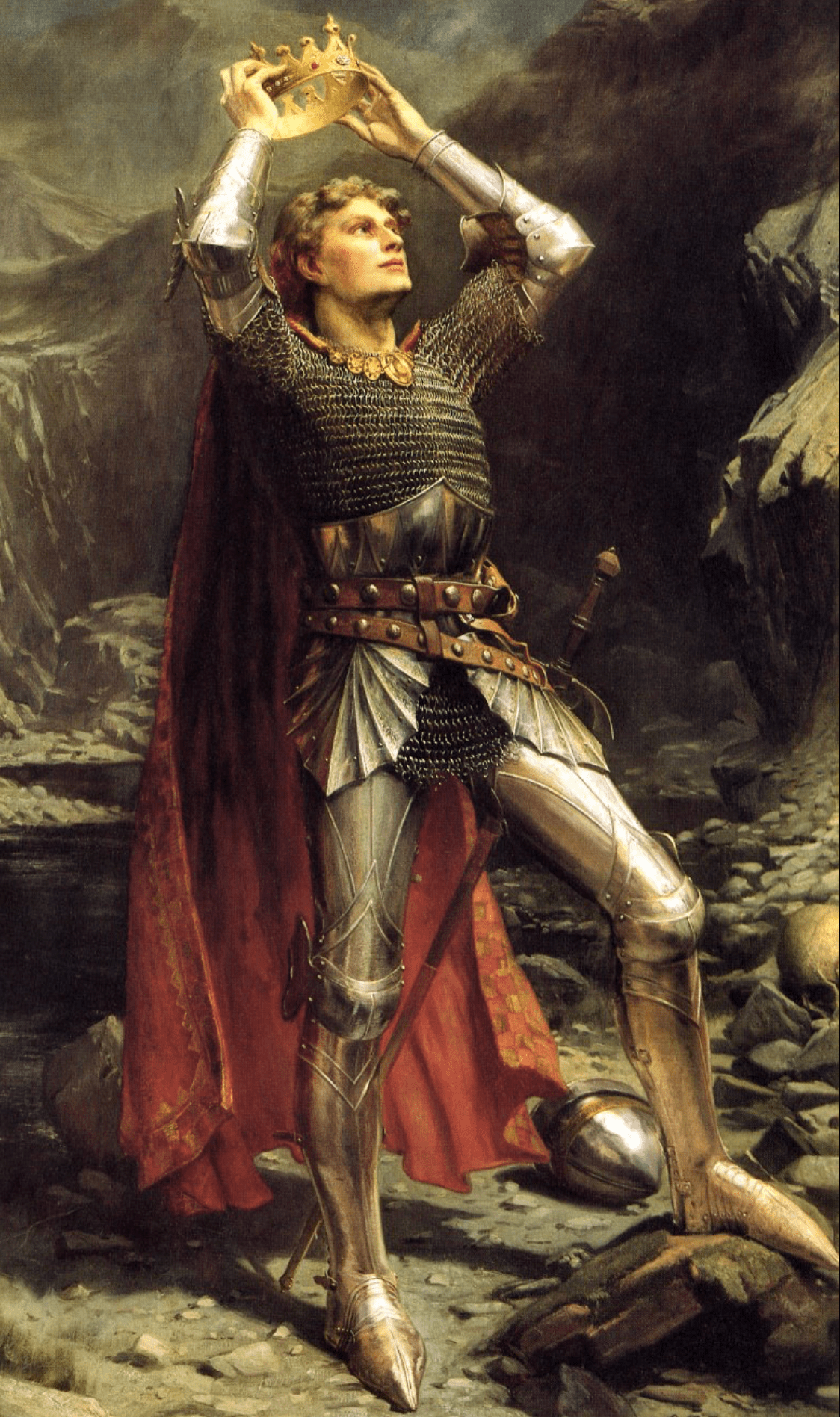
Many people will be generally familiar with the telling of the story of King Arthur and his Knights of the Round Table, but how many of you will have realised the parallels between this epic tale and the tasks of the Adept?
The telling of Arthur’s tale usually revolves around three principle protagonists, Arthur, Guinevere, and Lancelot, with a forth protagonist Mordred added in towards the end of the story. The opening sentence from the Wikipedia article on Lancelot provides a succinct summary.
“Lancelot du Lac (meaning Lancelot of the Lake), alternatively also written as Launcelot and other spellings, is one of the Knights of the Round Table in the Arthurian legend. He typically features as King Arthur’s greatest companion, the lord of Joyous Gard and the greatest swordsman and jouster of the age – until his adulterous affair with Queen Guinevere is discovered, causing a civil war which was exploited by Mordred and brings about the end of Arthur’s kingdom.”
In psychological terms, the following associations could be made:
– Arthur as the True Self
– Guinevere as the Collective Unconscious
– Lancelot as the Ego, and
– Mordred as the Shadow.
However, for the more advanced student of the G.D. the following associations may help interpret Arthur’s legend:
– Arthur as the Higher Will, the Lower Genius or Viceroy of the Higher Genius, the Higher human Self, and God of the Man
– Guinevere as the Eternal Soul, the Soul of Nature, and the Shekinah
– Lancelot as King of the Physical Body, and the Lower Will
– Mordred as the Evil Persona
The tale of King Arthur is one of romance, and ultimately one of tragedy, as the Kingdom of Arthur is brought to its knees by civil war and strife. Had it a happier ending, Lancelot (Lower Will and ego) would have remained faithful to his King (Higher Will and Lower Genius) as a loyal Steward of the Realm (Assiah), and protector of Guinevere’s (Eternal Soul and Shekinah) chastity, while his Lord was off fighting in foreign lands. On the return of his King there would have been no civil war, and Lancelot would have vacated his role as Steward so that the rightful King could be seated on his Throne. Even Mordred (Evil Persona) would have bended knee to the King.
Now read the following with the above in mind:
“To render the King of the Body, i.e., the Lower Will, obedient to, and anxious to execute the commands of the Higher Will; so that he be neither an Usurper of the faculties of the Higher, nor a Sensual Despot; but an initiated Ruler and an anointed King; the Viceroy and Representative of the Higher Will, because inspired thereby, in his Kingdom which is the Man.
“Then shall it happen that the Higher Will, i.e., the Lower Genius, shall descend into the Royal Habitation, so that the Higher Will and Lower Will shall be as one, and the Higher Genius shall descend unto the Kether of the Man, bringing with him the tremendous illuminations of his Angelic Nature: and the man shall become what was said of Enoch:- ‘And Chanokh made himself to walk for ever close with the Essence of the Elohim, and he existed not apart, seeing that the Elohim took possession of his being’ (Gen. V.24).
“And then also this shalt thou know, that the Nephesh of the Man shall become as the Genius of the Evil Persona, so that the Evil Persona itself shall be a Power of the Divine in the Qlippoth, as it is said:- ‘Whither shall I go from Thy Spirit, or whither from Thy Presence shall I flee? If I ascend up to heaven Thou art there; if I make my bed in hell, behold Thou art there’ (Ps. 139.7).”
As Carl Jung would have testified, fables and myths are not always what they appear to be, and buried within their plot one can often find spiritual truths garnered from the bosom of the Collective Unconscious, the Soul of Nature (and Man).
Kasmillos
