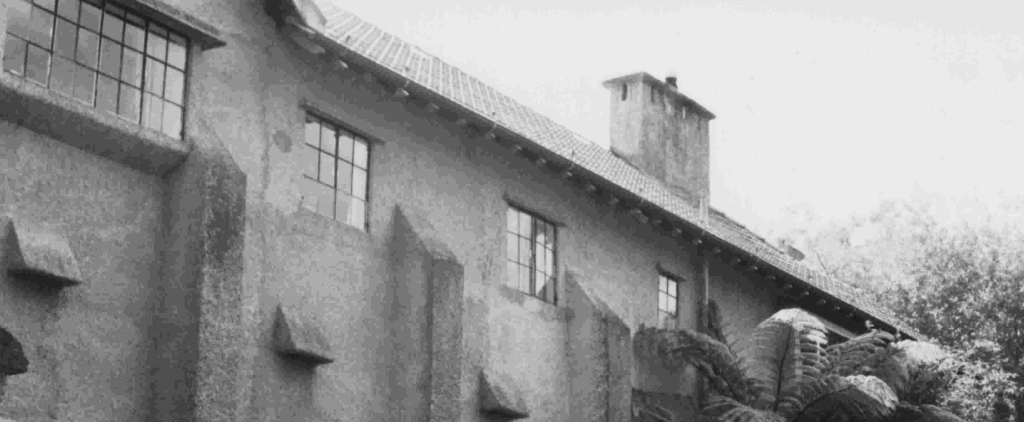
The Smaragdum Thalasses Temple and the Golden Dawn Tradition in New Zealand
Although frequently referred to under the collective name “Golden Dawn,” the Smaragdum Thalasses Temple did not belong to the original Order as it existed prior to the schisms of the early twentieth century. It was founded under the authority of the Stella Matutina, the organisation formed by Dr. Robert William Felkin following the dissolution of the original Order. Nevertheless, the temple stood in direct continuity with the Golden Dawn tradition, both in lineage and practice, preserving ritual forms, grade structures, and instructional materials derived from late nineteenth-century Golden Dawn sources.
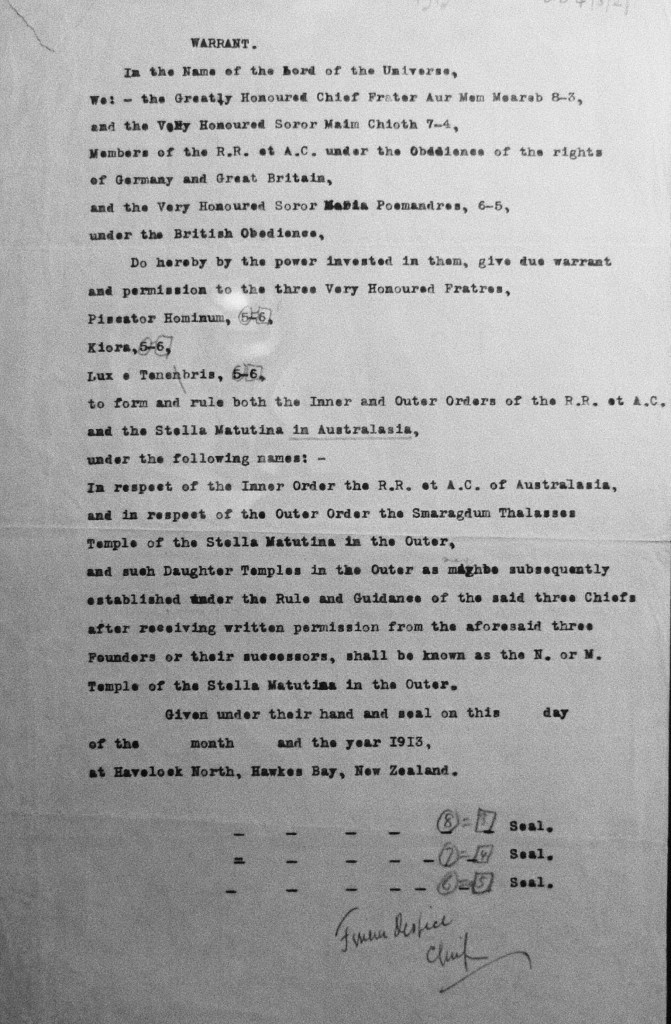
Photo of the draft copy of the Warrant, viewed in the collections of the Library and Museum of Freemasonry, London.
The origins of the temple lie in the cultural and religious circumstances of Havelock North in the years preceding the First World War. From around 1907, a group of residents—drawn largely from Anglican, Quaker, and former Theosophical backgrounds—met regularly for prayer, meditation, and discussion. This group, later associated with what became known as the Havelock Work, sought a disciplined form of Western esoteric training grounded in established religious and moral frameworks. Their activities combined inward spiritual discipline with outward cultural and communal initiatives that exercised a marked influence on village life.
Through personal connections in Britain, particularly with Anglo-Catholic clergy who were members of the Stella Matutina, this group was directed toward Dr. Felkin, one of the senior figures of the post-Golden Dawn era. Acting on this guidance, Felkin, his wife Harriot, and their daughter Ethelwyn travelled to New Zealand in late 1912. During an intensive three-month visit they formally established the Smaragdum Thalasses Temple, initiating twenty-four men and women and conferring authority on local Chiefs to govern both the Outer and Inner Orders in New Zealand and Australasia.
From its establishment in 1912, the ritual and instructional work of Smaragdum Thalasses relied heavily on original Golden Dawn instruction papers, particularly those developed during Felkin’s earlier involvement with the Isis-Urania Temple No. 3 in London. While adaptations occurred over time, the core curriculum preserved the structure, symbolism, and practical methods characteristic of the late Victorian Golden Dawn system. In this respect, Whare Ra functioned not as an experimental or syncretic offshoot, but as a conservator of earlier traditions.
The temple building itself, completed in 1913 and known publicly as Whare Ra (“House of the Sun”), was designed by the architect James Chapman-Taylor, a long-standing senior member of the Order. Constructed of reinforced concrete and incorporating a subterranean temple and seven-sided Vault, the building was designed specifically to support the ceremonial requirements of the Golden Dawn initiatory system. Its architectural form and symbolic features were integral to the work conducted within it.
In 1916, recognising the need for experienced central leadership, the New Zealand members invited the Felkins to return and settle permanently in Havelock North. From that point onward, Smaragdum Thalasses assumed a position of increasing importance within the Stella Matutina. Following the decline of the English temples during and after the First World War, Whare Ra became the effective mother temple of the Order, maintaining continuity of practice and authority at a time when many earlier centres had ceased to function.
Throughout its existence, the membership of Smaragdum Thalasses appears to have been drawn predominantly from orthodox Christian backgrounds, particularly Anglican and Quaker communities. While individual members held a range of personal interpretations, the work of the temple in New Zealand was characterised by disciplined ritual practice, moral seriousness, and an emphasis on personal responsibility rather than doctrinal innovation. The Order operated in deliberate secrecy, and its members often occupied prominent roles within local civic, educational, and religious institutions.
Following the death of Dr. Felkin in 1926, leadership passed primarily to Harriot Felkin, under whose stewardship the temple reached its numerical and organisational peak during the late 1920s and early 1930s. From 1936 onward she oversaw the publication of The Lantern, a journal produced for members of the Order that preserved teachings, reflections, and historical material connected with the work of Smaragdum Thalasses. These writings, together with surviving documents and recollections, form the principal record of the temple’s inner life.
Whare Ra continued its work largely unnoticed outside its immediate circles until its formal closure in August 1978, when the Chiefs declared that the temple had fulfilled its function. The subsequent sale of the building brought public attention to the existence of the subterranean temple and Vault and prompted renewed scholarly interest in what had long remained one of the least documented continuities of the Golden Dawn tradition.
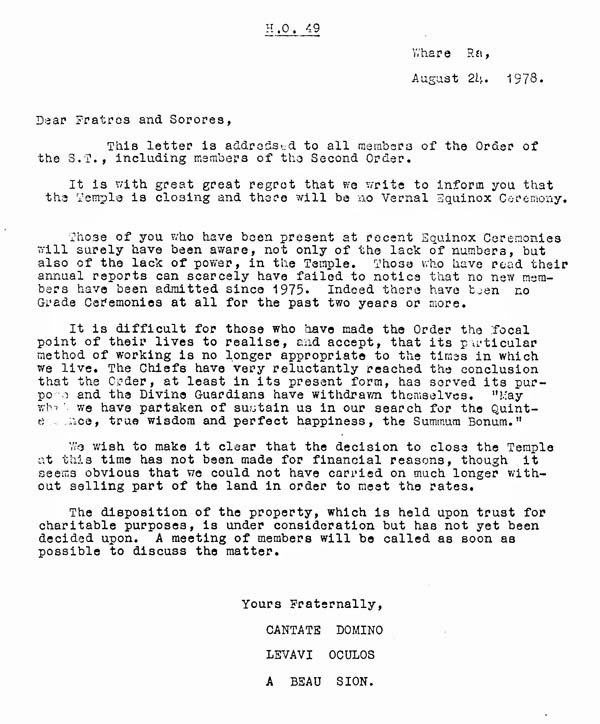
Letter sent to members informing them of the closing of the Temple, and signed by the three Chiefs of the Order. Held in a private collection.
As the final functioning temple of that tradition, and for a period the effective centre of the Stella Matutina, Whare Ra constitutes a unique case in the documented history of the Order. The materials preserved and presented here are intended to record that history with accuracy and restraint, drawing wherever possible on primary sources and the testimony of those who participated in the work.
- Often also spelt Smaragdum Thallasses in official documentation, and meaning “Emerald of the Sea.” ↩︎
